
Build a business that works in peak season and the shoulder months.

HVAC technician checking air-conditioning equipment with a digital gauge

HVAC performance changes with weather, installation mix, equipment cost and technician capacity. A profitable summer can still leave a cash gap later. Hata Advising helps HVAC owners build a financial plan that separates service, maintenance and replacement economics and carries the business through the full year.

Your fractional CFO works with your existing team on forecasting, profitability and operating decisions. Accounting cleanup and systems work can be scoped separately where needed.
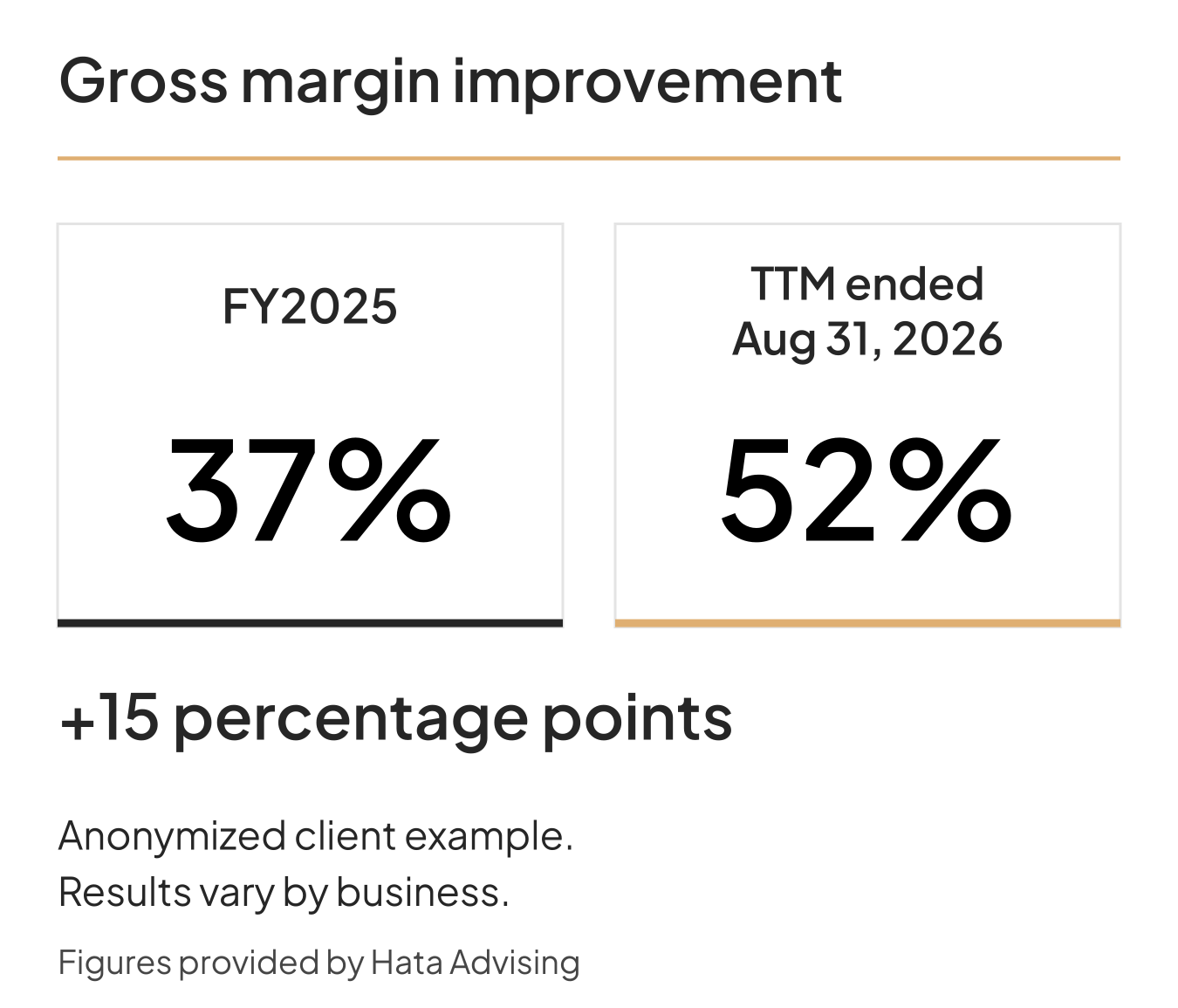
Anonymized client example: gross margin increased from 37% in FY2025 to 52% for the trailing twelve months ended August 31, 2026, an increase of 15 percentage points. Figures provided by Hata Advising; results vary by business.

One multi-trade engagement, one measured result

In Hata Advising’s published case study, an HVAC, electrical and plumbing company moved from 37% gross margin in FY2025 to 52% for the trailing twelve months ended August 31, 2026. This is one combined engagement, not a separate result for each trade. Results vary by business.

Read the work behind the result

What your HVAC CFO helps you decide

A recurring financial review built around the work your team performs.

  • Budget for seasonality. Build monthly revenue, labor and overhead plans around your actual seasonal pattern. Stress-test a mild season, slower replacement demand and overtime-heavy peak weeks rather than spreading the annual budget evenly.
  • See replacement margin clearly. Bring equipment, install labor, commissions, financing fees, permits and warranty work into the job review. Compare sold margin with completed-job margin and investigate the gap.
  • Understand maintenance agreements. Track active agreements, renewal patterns, service obligations and related cash timing. Distinguish cash collected up front from the work the business still owes.
  • Protect shoulder-season cash. Maintain a 13-week cash forecast around payroll, inventory, equipment purchases and debt service. Model the effect of slower collections before it becomes a cash emergency.
  • Match capacity to demand. Evaluate service and install productivity separately. Test the revenue and contribution needed to support another crew, truck or dispatcher without assuming peak-season demand lasts all year.
  • Review the right operating numbers. Use service and installation gross profit, paid field hours, callbacks, maintenance renewals and cash collections in a recurring owner review. Turn variances into a short action list.

Starting at $3,500/month

Monthly CFO engagements range from $3,500–$15,000/month, depending on scope and level of involvement.

Your fee reflects the number of entities, reporting needs, meeting cadence and accounting responsibilities included in the engagement.

Bookkeeping, cleanup and project-based work are scoped and priced separately.

Flexible engagement models

Ongoing fractional CFO. Recurring weekly or biweekly engagement, with a dedicated CFO embedded in your operations for a set number of hours per month.

Interim chief financial officer. Full-time, short-term coverage during transitions, leaves or vacancies.

Project-based advisory. Targeted support for system migrations, CRM-to-accounting integration, cash-to-accrual conversions, acquisition support and financial restructuring.

Need deal diligence? View Quality of Earnings Services.

Is your HVAC business ready for a fractional CFO?

These are useful starting points for the first conversation.

  • Busy months cover up weak shoulder-season performance.
  • Install revenue is increasing without a matching increase in gross profit.
  • Equipment and financing costs are not consistently captured by job.
  • Maintenance cash and future service obligations are hard to reconcile.
  • Hiring decisions rely on a few weeks of peak demand.
  • You need a budget that connects to dispatch and installation capacity.

Make the next HVAC growth decision with a clearer financial picture.

Bring your current reporting, job-costing questions and plans. We will discuss the right scope for your business.