

Every cash crisis I have seen up close had one thing in common: it was visible weeks earlier, in numbers the company already had. The payroll that got tight did not get tight that Friday. The sales tax payment did not become due the day the notice arrived. The cash was always going to run short in week nine. Nobody was looking at week nine.
The 13-week cash flow forecast is the report that looks at week nine. It is the first tool I build at almost every engagement, and it is the one owners tell me they would keep if they could only keep one.
What It Is
A 13-week cash flow forecast is a weekly schedule of cash in, cash out, and ending bank balance, projected thirteen weeks forward and updated every week.
Thirteen weeks is not arbitrary. It is one quarter: far enough out to see problems while you can still do something about them, close enough in that the numbers stay honest. Forecast six months by month and you get a guess. Forecast thirteen weeks by week and you get a schedule.
Weekly matters as much as thirteen. A monthly view is too high a view: it nets out the swings inside the month, so the month can show plenty of cash while a week in the middle of it goes negative. Payroll on the fifth does not care that the big deposit lands on the twenty-fifth. And if you run biweekly payroll, two months a year carry three payrolls instead of two, which a monthly view hides completely. Cash problems happen on dates, not in months, so the forecast has to live in weeks.
It is also built on cash, not accounting. Revenue does not appear in it. Collections do. An invoice you sent means nothing to this report until the week the money is expected to hit the account.
Why The Bank Balance Fails You
Most owners run cash off the bank app, and the bank app answers the wrong question. It tells you what is there, not what is spoken for.
The problem is timing. Payroll hits every week or two. Loan payments hit monthly. Sales tax hits monthly or quarterly. Insurance renews once a year in one large draft. Big customer payments land in lumps. On any given Tuesday the account can look healthy while three of those are converging on the same week next month.
That is why the bank balance produces the classic sequence: flush, comfortable, surprised. The forecast exists to delete the third step.
What Goes In It
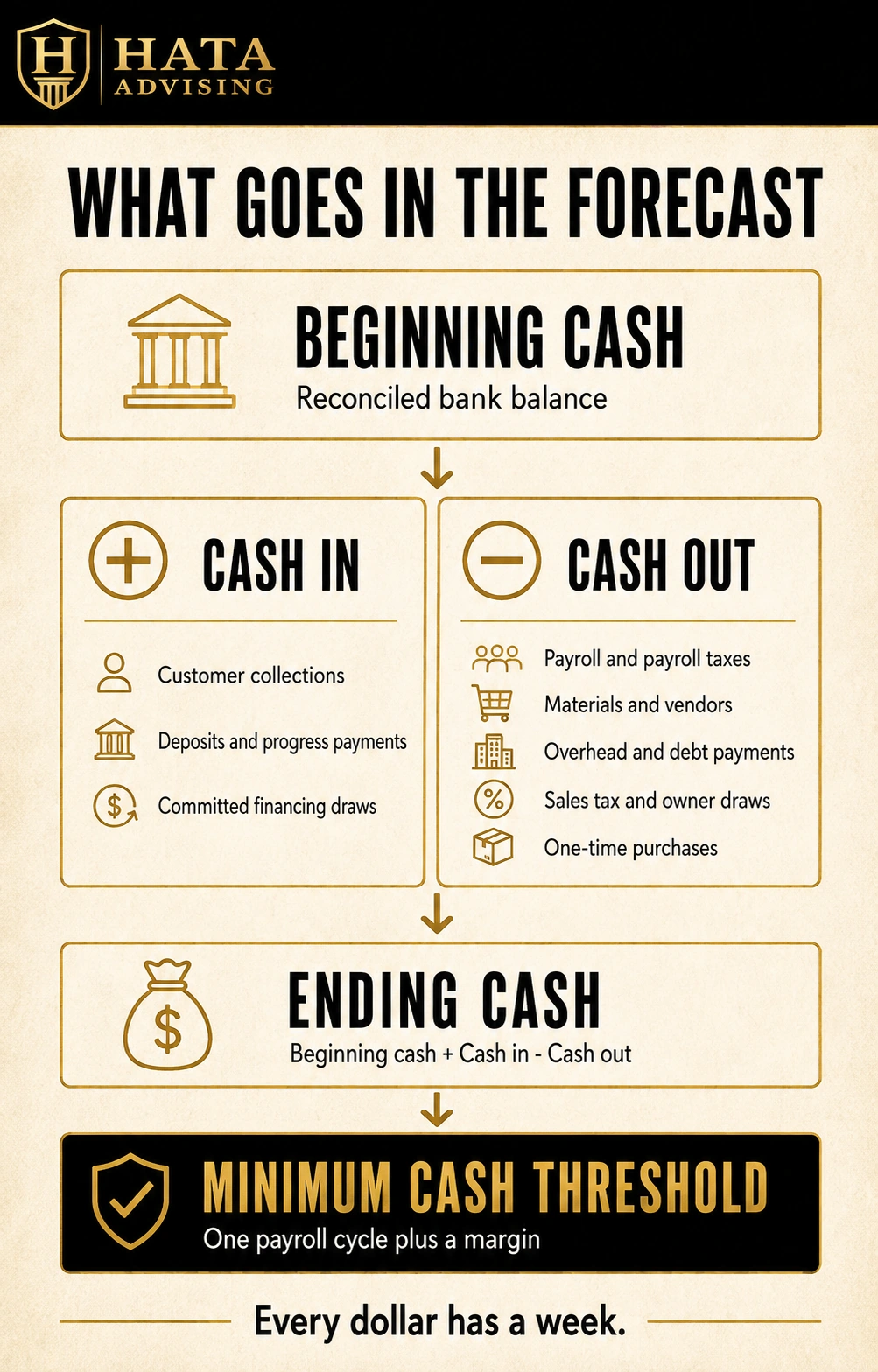
One column per week, thirteen weeks across. The rows:
Beginning cash. The reconciled bank balance, which is one more reason the books have to be clean.
Cash in:
- Collections from receivables, placed in the week you expect payment, not the week you invoiced
- Deposits and progress payments on sold work
- Financing draws, only if already committed
Cash out:
- Payroll and payroll taxes, every cycle, the anchor of the whole report
- Material and vendor payments
- Rent, utilities, insurance, software
- Loan payments and credit card payments
- Sales tax remittance in the week it is actually due
- Owner draws
- One-time items: the truck, the annual policy, the tax deposit
Ending cash. Beginning cash plus in, minus out, carried into the next week as its beginning balance.
Then one more line: your minimum cash threshold, the number you refuse to go below, typically enough to cover a full payroll cycle plus a margin. Any week where ending cash crosses that line is the whole point of the report. You now know the date of a problem that has not happened yet.
The Rules That Make It Work
The report is simple. The discipline is the product.
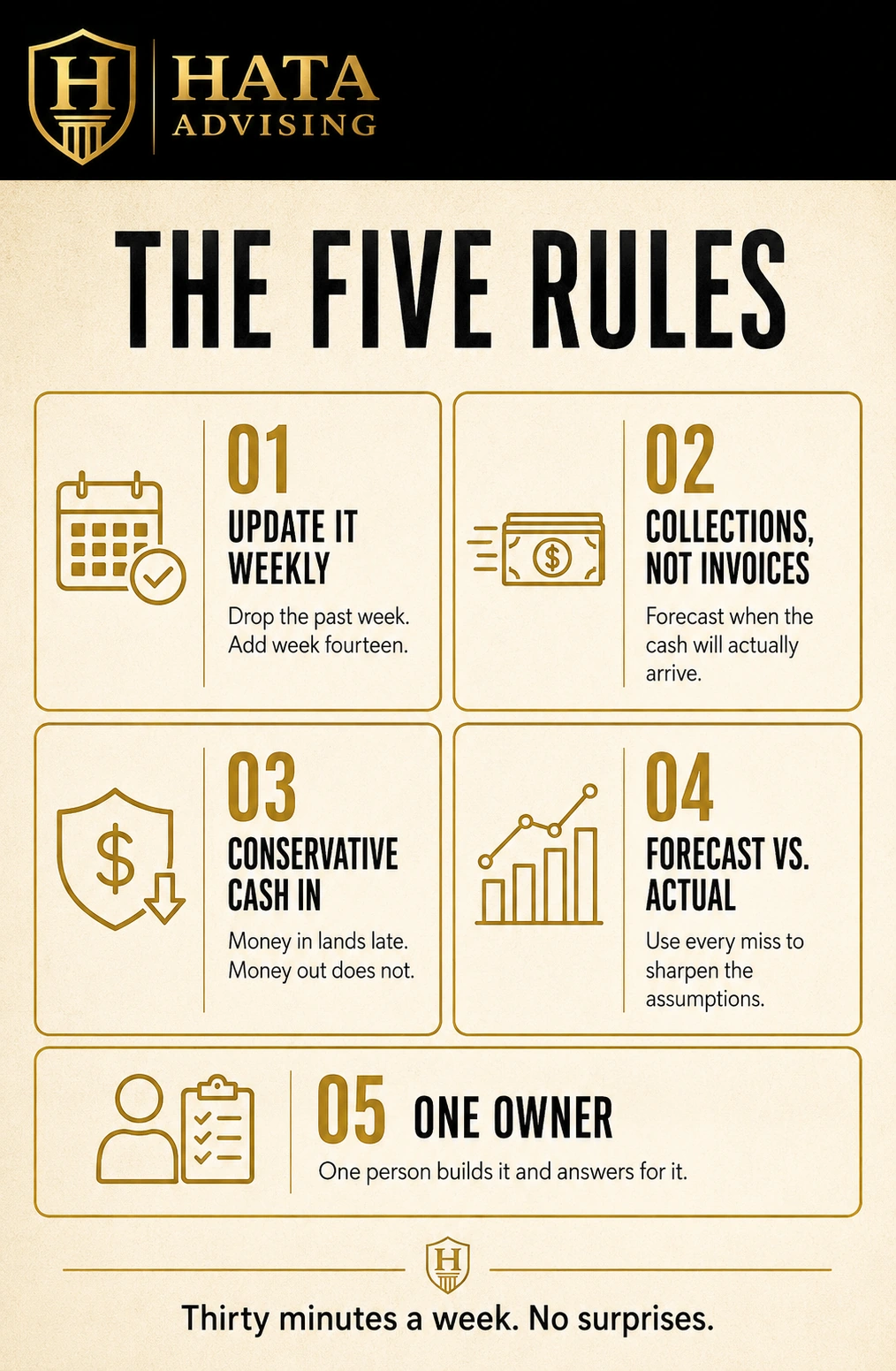
- Update it every week. Thirty minutes, same day each week. Drop the week that just ended, add week fourteen, correct what changed. A stale forecast is worse than none because it is confident and wrong
- Collections, not invoices. Forecast when customers actually pay, based on how they actually behave. The commercial GC who pays in 55 days goes in at 55 days no matter what the invoice says
- Pessimistic on money in, precise on money out. Inflows land late. Outflows never do
- Compare last week’s forecast to what actually happened. The gap tells you where your assumptions are wrong, and the forecast gets sharper every month you run it
- One owner. Somebody specific builds it and answers for it, whether that is your bookkeeper, your controller, or your fractional CFO
The Decisions It Changes
A forecast is only worth keeping if it changes what you do. This one does:
- Big purchases get a date. The truck question stops being can we afford it and becomes which week can we afford it
- Draws come out on schedule. Owner pay stops being whatever looks safe in the app
- The line of credit gets used early and on purpose. Drawing in week two because week nine is short is cheap. Discovering week nine in week nine is expensive, and sometimes it is not available at all
- Hiring gets timed. A new tech is a weekly cash commitment that starts before the revenue does. The forecast shows whether you can carry the gap
- The known lumps stop being surprises. Insurance renewal, quarterly sales tax, the tax deposit. All of it sits in its week, visible for three months before it lands
- Slow season gets planned in busy season. For seasonal trades this is the single biggest benefit. You can see October in July
What This Looked Like In Practice
A plumbing and drains company came to us after a payroll scare. Profitable on the P&L, growing, and the owner had covered a Friday payroll from personal funds because a financing payment landed later than expected. Everything in the business was run off the bank balance.
We built the 13-week forecast in the first two weeks of the engagement. It did not require new software. It required clean books to start from, honest timing on customer payments and financing payouts, and a weekly half hour.
The next tight week showed up on the forecast seven weeks before it arrived. The company drew on its line early, moved one vendor payment, and shifted a planned equipment purchase back a month. The week came and went without a scramble. That is the entire product: the same events, minus the emergency.
The Bottom Line
Profit is an opinion about a period. Cash is a fact with a date on it. The P&L cannot tell you whether you can make payroll in week nine, and the bank balance cannot tell you until you are standing in week nine. The 13-week cash flow forecast is how you stop learning about cash problems from your bank account.
Thirty minutes a week. One page. No surprises.