

Plenty of HVAC, electrical, and plumbing companies show a healthy profit on paper and still feel broke every month. Revenue climbs, the year nets a profit, and yet cash flow is a constant scramble. The problem is rarely weak sales. It is that the single largest cost in the business is hiding in plain sight, and until you can see it, you cannot fix it.
Why a Profitable Business Can Still Run Out of Cash
Profit and cash are not the same thing, and a business can have plenty of one while starving for the other. Your income statement can report a strong year even as your bank account tells a very different story.
Profit measures performance over time. Cash flow measures what is actually in your hands right now. When the two diverge, it is almost always because a major cost is being absorbed quietly, spread across the business in a way that never shows up as a single, fixable line.
Why Labor Hides the Cash Flow Leak
In most home-services businesses, technician labor is the biggest expense by a wide margin. Yet it is almost never tracked at a level that tells you anything useful.
Hours go into a payroll system as one lump number, and that number quietly absorbs every kind of time: hours spent on billable work, hours sitting idle between calls, time spent driving, and everything else that is neither productive nor billed.
When all of that lands in one bucket, you cannot see your true cost of delivering the work. A job that looks profitable may be carrying two hours of unbilled idle and drive time nobody priced in. Multiply that across a fleet of technicians over a full year, and the gap between paper profit and bank balance starts to make sense.
Break Labor Into Four Buckets
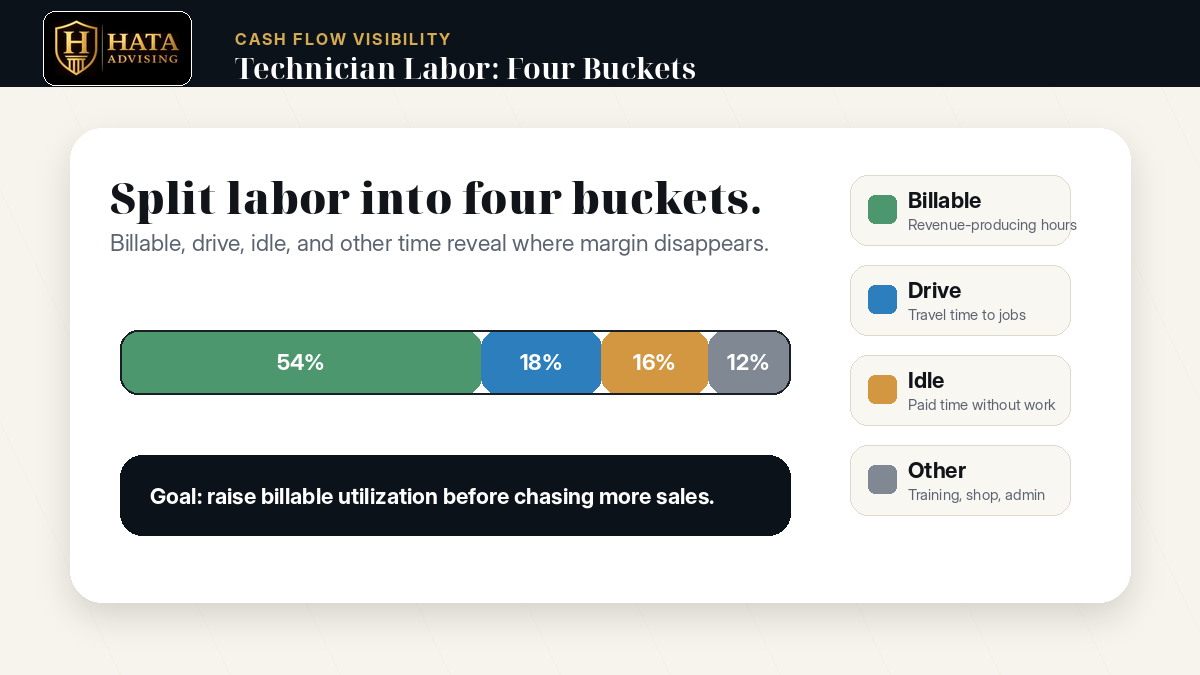
The first move is to stop treating labor as one number. Every technician hour should be classified into one of four categories:
- On-job billable time, the hours that directly produce revenue
- Idle time, paid hours with no work attached
- Drive time, which may or may not be billed depending on how you price
- Other, the catch-all for training, shop time, and administrative work
Once you classify hours this way, week over week, the picture changes quickly. You can finally see your true utilization rate, the share of paid hours that actually generate revenue. You can tell whether idle time is a scheduling problem or a demand problem. And you can calculate the real labor cost buried in each job instead of guessing at it.
Layer On Margin and Customer Economics
Labor visibility is the foundation. Two more views build on top of it and turn raw data into decisions.
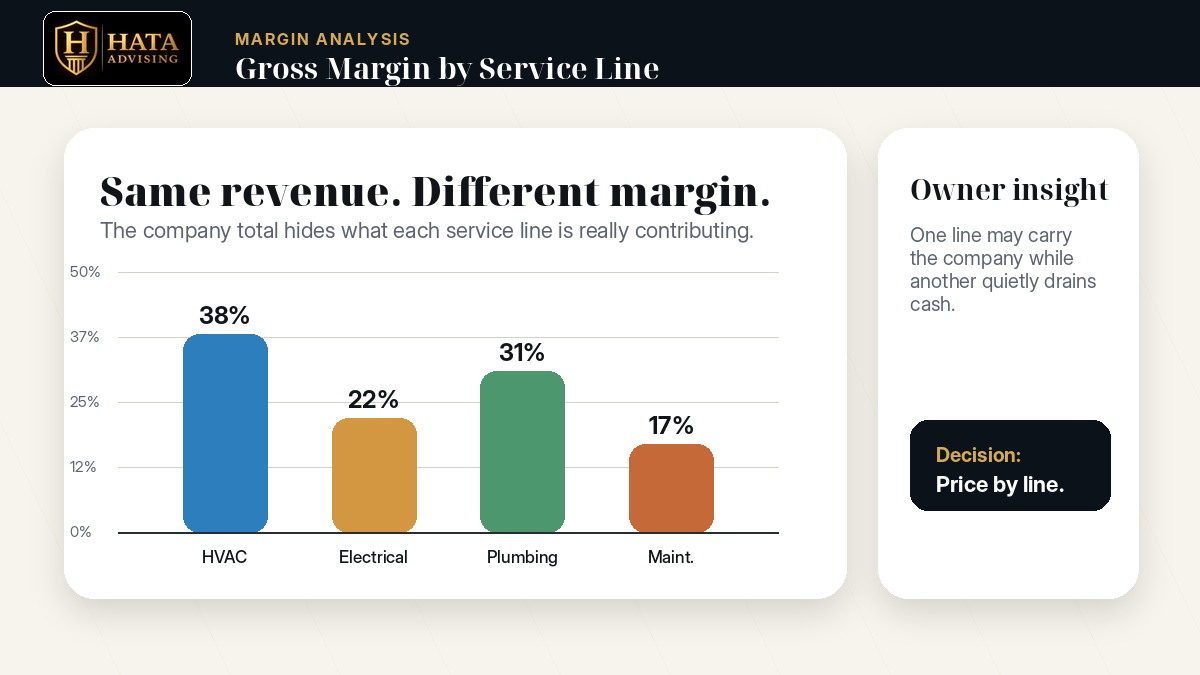
Gross Margin by Service Line
Measuring gross margin separately for each service line tells you which part of the business is carrying the company and which is just along for the ride. It is common for an owner to assume both lines pull their weight, then discover that one is quietly subsidizing the other. That single insight can reset how you staff, price, and spend.
Acquisition Cost Versus Lifetime Value
Comparing what you spend to win a customer against what that customer is worth over time tells you whether your marketing is an investment or a leak. Without it, ad spend is a guess. With it, you know which channels to feed and which to cut.
What This Looked Like in Practice
A growing home-services company running both HVAC and electrical was profitable on paper but could not see where its labor dollars were going. We built week-over-week tracking that classified every technician hour into billable, idle, drive, and other, then layered gross-margin analysis by service line and acquisition cost against lifetime value on top.
For the first time, the owner could see which segment was actually carrying the business and which was bleeding, and could set staffing and pricing decisions from real numbers instead of gut feel. The revenue had been there all along. What had been missing was the ability to see it.
How to Start This Week
You do not need new software to begin. A few steps will surface most of the leak:
- Have technicians log their hours into the four buckets for two weeks, even roughly
- Pull gross margin for each service line separately, rather than as a company total
- Add up what you spent on marketing last quarter and divide by the customers it produced
These three numbers alone will tell you more about your cash flow than a year of income statements.
The Bottom Line
If your business is profitable on paper but tight on cash, the answer is almost never to sell more. It is to see what you already have. Break labor into its real categories, build margin and customer economics on top, and the leak usually turns out to be hiding inside a number you were treating as one thing when it was really four.
If your numbers look profitable but your bank account disagrees, Hata Advising can help you find the leak. Book a free consultation to see exactly where your cash is going.