

Most owners do not lose money because they made a bad call. They lose it because they made a reasonable call on numbers that were wrong. The price increase that was already too late. The truck that was bought out of a bank balance that had four weeks of unpaid bills sitting behind it. The tax bill nobody saw coming. None of those are judgment failures. They are data failures, and data failures are cheaper to fix than the decisions they cause.
What Clean Books Actually Means
Clean is not the same as current. Plenty of companies have every transaction synced and categorized and still have books that cannot be trusted. Clean means all of the following are true:
- Every bank, credit card, and loan account is reconciled monthly to the actual statement, and the ending balance agrees
- The month closes on a date, not whenever someone gets to it
- Revenue and cost are coded the same way every month, so a trend line means something
- AR and AP reflect what is actually owed to you and by you, not stale invoices nobody cleared
- Job costing ties back to the P&L instead of living in a separate spreadsheet with its own answer
- The balance sheet gets reviewed, not just the P&L
Reconciliation Is The Floor, Not The Finish Line
Reconciling means every transaction has been matched to the statement and the ending balance agrees to the penny. It does not mean the balance looks about right.
It also does not stop at the operating account. Credit cards, lines of credit, term loans, payroll clearing, and merchant deposits all need to reconcile. A company that reconciles the bank and ignores the cards is verifying maybe half of its spend, and the unverified half is usually the half full of personal charges, duplicate subscriptions, and material purchases coded to whatever account was easiest.
Reconciliation is what makes everything above it believable. Without it, your gross margin, your job costing, and your cash forecast are all opinions.
What Bad Books Cost You
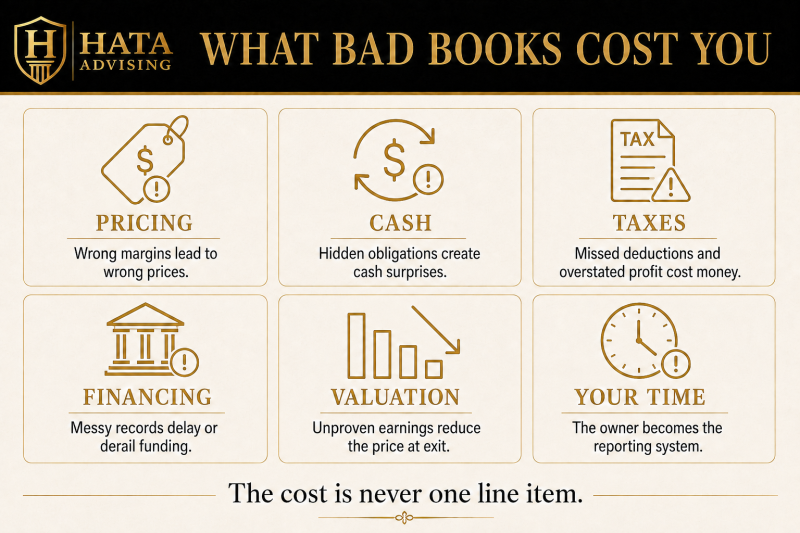
The cost is never a line item. It shows up in six places:
Pricing. If labor burden and material are miscoded, your gross margin is fiction. You hold price when you should raise it, or you chase volume on work that loses money on every job.
Cash. Sales tax collected but not tracked, undeposited funds that keep growing, loan principal and interest lumped together. You feel flush and then you are not.
Taxes. Missed deductions cost you money. Overstated profit costs you more. Both come from the same place.
Financing. Lenders and SBA underwriters want reconciled statements that tie to the tax return. Messy books add weeks to underwriting, invite conditions you did not want, and sometimes end the conversation. Nobody funds what they cannot verify.
Valuation. At exit, a buyer discounts what they cannot prove. Every question a quality of earnings analysis cannot answer from your records turns into a price reduction, a bigger escrow, or more of the price pushed into an earnout. Clean books are worth real dollars at the table.
Your time. When the books cannot be trusted, the owner becomes the reporting system. You are the only one who knows which numbers are wrong and by how much, and that job never gets delegated.
Signs Your Books Are Not Clean
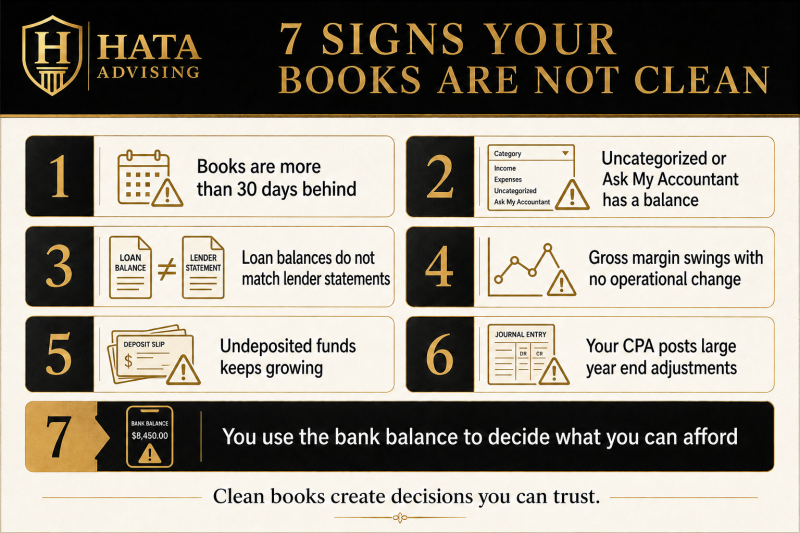
You do not need an audit to know. Any of these is enough:
- The books are more than 30 days behind
- Uncategorized or Ask My Accountant has a balance
- Loan balances on the balance sheet do not match the lender’s statement
- Gross margin moves several points month to month with no operational change
- Undeposited funds grows every month and never clears
- Your CPA posts large adjusting entries at year end
- You use the bank balance to decide what you can afford
The last one is the most common and the most expensive.
What This Looked Like In Practice
A home services company came to us with books four months behind and credit cards that had never been reconciled. Every material purchase was coded to a single cost account, so job costing was being run out of a spreadsheet that did not agree with the financials.
We caught the accounts up, reconciled every account including the cards and the equipment notes, rebuilt the chart of accounts around how the business actually runs, and set a monthly close calendar with a hard date.
What surfaced: install gross margin was several points below what the owner believed, duplicate vendor payments had gone out and were recovered, and a sales tax liability had been accruing unrecorded. The owner had been pricing against a margin that did not exist.
The cleanup did not change how the business operated. It changed what the owner could see, and every decision after that was made on numbers that held up.
The Bottom Line
Bookkeeping is not paperwork. It is the instrument panel. Every decision you make about price, hiring, equipment, financing, and eventually selling is only as good as the numbers underneath it, and the numbers are only as good as the reconciliation nobody sees.
The cost of clean books is a known monthly number. The cost of dirty books is unknown, unbudgeted, and always found later. For help with reconciliations and the monthly close, see our accounting and controller support.