

For a company with momentum, buying a business can be the fastest growth move available. One deal can add a customer base, a crew of trained people, and a second revenue stream that would take years to build from scratch. It can also be the fastest way to burn cash and management attention on someone else’s problems. The difference is rarely luck. It comes down to buying for the right reason, verifying what you are buying, and doing the unglamorous work after closing.
When Acquisition Beats Organic Growth
Acquisition makes sense when it buys you something that is slow or expensive to build: skilled people in a tight labor market, a customer base in a territory you want, a service line adjacent to yours, or capacity you cannot hire fast enough. In those cases you are paying for time, and time is often worth the premium.
It is the wrong move when it is covering for a weakness. If your core business has thin margins, loose financials, or an owner already stretched past capacity, an acquisition does not fix any of that. It multiplies it. A deal adds complexity on day one and returns value only later, so the acquirer needs a stable base and real management bandwidth before taking one on. Buy from strength, not to escape a problem.
What to Verify Before Buying a Business
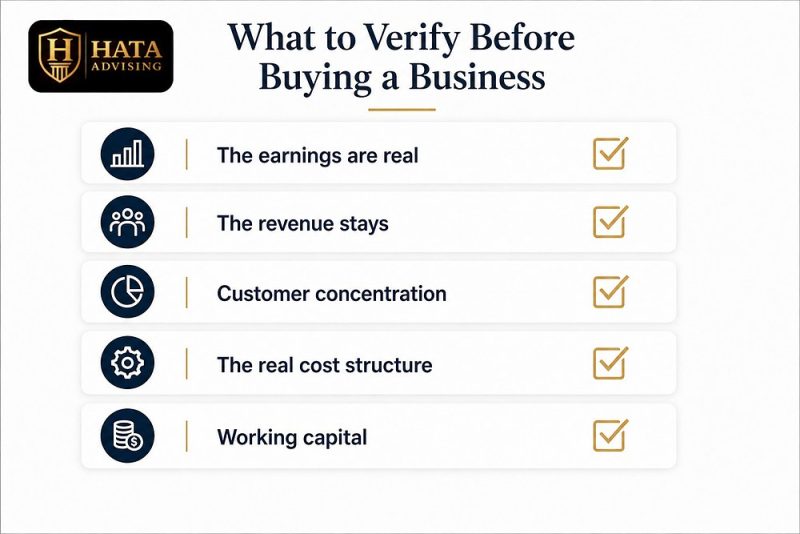
The seller’s story and the seller’s numbers are two different things, and the gap between them is where buyers get hurt. Before money moves, verify:
- The earnings are real. Test what the business actually produces, not what the listing claims. If the books are unreliable, rebuild the picture from bank records, deposits, and source documents
- The revenue stays. How much walks out the door with the seller’s relationships, and how much is truly tied to the business
- Customer concentration. A target where a few customers drive most of the revenue is a different risk than one with a broad base
- The real cost structure. Under-market owner pay, family on payroll, deferred maintenance, and equipment near end of life all change what the business will cost you to run
- Working capital. What has to stay in the business at closing for it to operate on day one without a cash infusion from you
This is the same quality of earnings discipline buyers will one day apply to you, pointed the other way. Skipping it does not save money. It just moves the cost to after closing, when you have no leverage left.
Structure the Deal Around What You Learn
Diligence findings should shape the structure, not just the price. Clean, verifiable earnings can justify more cash at close. Uncertainty argues for a seller note or an earnout that ties part of the price to the business actually performing. A seller staying on for transition changes what you can pay versus one leaving the day after closing. There is almost never one right structure, so model several side by side and let the risk you found decide how the payments work.
The First 100 Days: Where the Deal Is Actually Won
Most acquisitions do not fail at the closing table. They fail in the months after, when integration gets improvised. The value you paid for lives in people and customers, and both are watching closely in the first weeks. A few priorities matter more than everything else:
- Keep the people. The technicians and key staff are most of what you bought. Meet them early, be clear about pay and roles, and give them a reason to stay through the transition
- Hold the customers. Communicate the change simply, keep service levels steady, and do not change pricing or branding in month one
- Get one set of books fast. Move the acquired company onto your accounting and job-costing systems quickly, with a clean opening balance sheet, so you can actually see whether the deal is performing
- Change deliberately. Fix what is broken, but resist rebuilding everything at once. Every change spends trust with the team you just inherited

Set a simple integration scorecard before closing: revenue retention, technician retention, and gross margin on the acquired work, reviewed monthly. If those three hold, the deal is working. If one slips, you want to know in month two, not year two.
What This Looked Like in Practice
A home-services owner wanted to acquire a smaller plumbing company but was not sure what it was really worth or how to structure the purchase. The target’s books could not be taken at face value, so we verified the earnings from the ground up, working from bank activity and source records rather than the seller’s reports. We then modeled the target’s true economics, laid out several deal structures with the cash, risk, and tax tradeoffs of each, and prepared the owner for the negotiation.
An intimidating one-shot decision became a clear set of options with verified numbers behind each one. The owner walked in knowing what the business actually earned, what to offer, and how to structure the payments around the risk that remained.
The Bottom Line
Buying a business is buying time, and it only pays when three things line up: you are acquiring from strength rather than covering a weakness, you have verified what the business actually earns instead of trusting the story, and you treat the first hundred days as the second half of the deal. Price gets the headlines. Verification and integration are where the money is actually made or lost.
Considering an acquisition, or already in conversations with a seller? Hata Advising verifies target earnings, models deal structures, and builds the integration plan so you buy with clear eyes. Request a consultation or call 801.631.5123.