

Ask an owner how the business is doing and almost every answer comes from the P&L. Revenue is up. Margin held. We had a good month. Ask a lender or a buyer the same question and they turn to a different page first. They read the balance sheet, and they read it before they read anything else.
There is a reason for that. The P&L covers a window and then resets. The balance sheet does not reset. It carries everything the business has done since the day it opened, and it is the only statement that has to be right for the others to mean anything.
The P&L Is A Story. The Balance Sheet Is The Record.
A P&L tells you what happened between two dates. Twelve months of it get closed out and the counter goes back to zero. Whatever was misclassified along the way disappears from view.
The balance sheet is cumulative. Every year of profit, every distribution you took, every loan you signed, every dollar sitting in receivables is still on it. Nothing rolls off. That is what makes it uncomfortable, and it is exactly why it is useful. You cannot have a good year on the balance sheet by having a good quarter.
Where Your Profit Actually Went
The most common question in a fractional CFO conversation is some version of this: the P&L says we made good money, so why is there nothing in the bank?
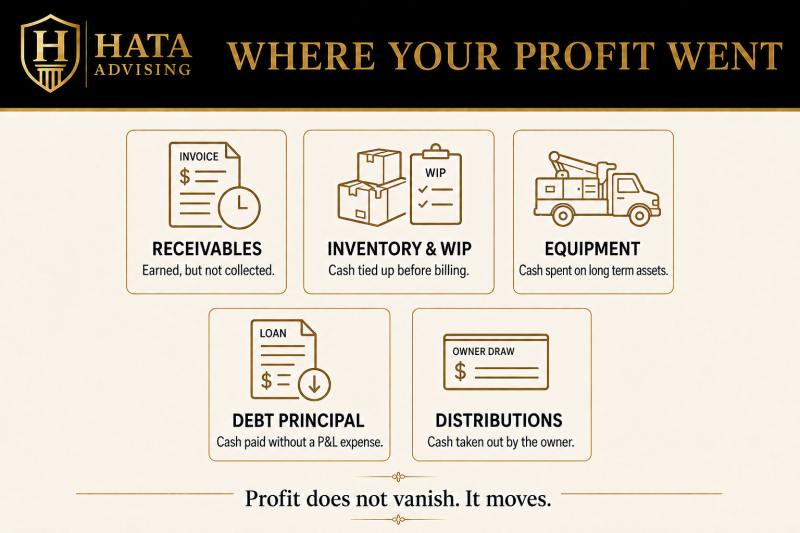
The balance sheet answers it every time. Profit does not vanish. It moves, and it moves into a small number of places:
- Receivables. You earned it, you booked it, the customer has not paid it. Common on commercial and new construction work
- Inventory and unbilled work. Material sitting on the shelf or in a truck, and jobs in progress you have paid for but not invoiced
- Equipment. A truck purchase does not touch the P&L the way writing the check touches your cash
- Debt principal. Principal payments reduce what you owe and never appear as an expense. On an equipment-heavy company this is often the single biggest gap between profit and cash
- Distributions. Money you took out. Not an expense, and one of the most common surprises when an owner finally sits down with the equity section
What a Balance Sheet Review Can Reveal
The statements are connected, and a balance sheet review can reveal errors that a P&L review misses.
Miscode a loan payment as an expense and the loan balance on the balance sheet stops matching the lender. Skip a bank reconciliation and cash on the books drifts from cash in the account. Book a customer deposit as revenue and you have income you have not earned sitting where a liability belongs. Forget to record sales tax collected and it accrues invisibly until the notice arrives.
Reconcile balance-sheet accounts to bank and lender statements and supporting schedules, then review revenue and expense classifications separately. A balance sheet that reconciles is an important control, but it does not prove every P&L category is correct.
Six Lines To Read Every Month
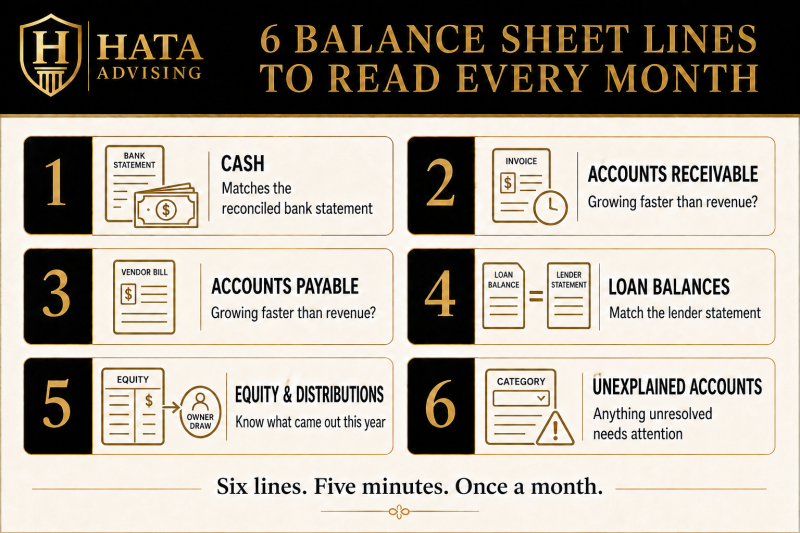
You do not need to interpret the whole statement. Six lines, five minutes:
- Cash. Does it match the reconciled bank statement, not the bank app balance
- Accounts receivable. Is it growing faster than revenue. If yes, you are financing your customers
- Accounts payable. Is it growing faster than revenue. If yes, your vendors are financing you, whether you decided that or not
- Loan balances. Do they match the lender’s statement. A gap here means principal and interest are being coded wrong
- Equity and distributions. What has come out of the business this year, in one number
- Anything you cannot explain. Uncategorized, Ask My Accountant, Opening Balance Equity, suspense. A balance in any of these means something is unresolved
What Lenders And Buyers Read First
When you apply for a line of credit, an equipment loan, or SBA financing, the underwriter is not primarily asking whether you are profitable. They are asking whether you can carry debt and whether your records are credible. Both of those questions get answered on the balance sheet.
The same is true at exit. A buyer’s diligence team starts with the balance sheet because that is where undisclosed liabilities, uncollectible receivables, and unrecorded obligations show up. Working capital, which is a balance sheet calculation, is negotiated separately from price and routinely moves a deal by real money. Owners who have never looked closely at their own balance sheet tend to learn what is on it at the worst possible moment.
What This Looked Like In Practice
A home services company was posting solid profit on the P&L and could not figure out why cash was tight every month. The owner assumed it was a collections problem.
The balance sheet said otherwise. Loan payments had been coded entirely to expense, so principal was never reducing the recorded debt and the balances no longer matched the lenders. Distributions had been running well above what the owner thought. Receivables had been climbing for two quarters without anyone tracking the trend.
None of it was fraud and none of it was unusual. It was three ordinary bookkeeping decisions that never got reviewed, and together they explained the entire gap between reported profit and actual cash. Once the balance sheet was corrected and reviewed monthly, the mystery stopped being a mystery.
The Bottom Line
The P&L tells you how the last month went. The balance sheet shows recorded assets, liabilities and equity. Read alongside the P&L and cash flow statement, it helps explain where profit went and where the records need attention. It is the statement lenders read first, the statement buyers read first, and the one almost every owner reads last.
Five minutes a month on six lines is the highest-return financial habit available to a business owner.